A Life Built Inside a Ideological Cage
When I look at Gerda Bormann, I see a woman who lived close to the center of Nazi power while remaining, in many ways, locked inside its domestic walls. Born Gerda Buch in 1909, she grew up in a hardline political household and later became the wife of Martin Bormann, one of Adolf Hitler’s most powerful inner circle figures. Her life was not ordinary, not quiet, and certainly not innocent. It moved like a blade through one of the darkest decades in modern history.
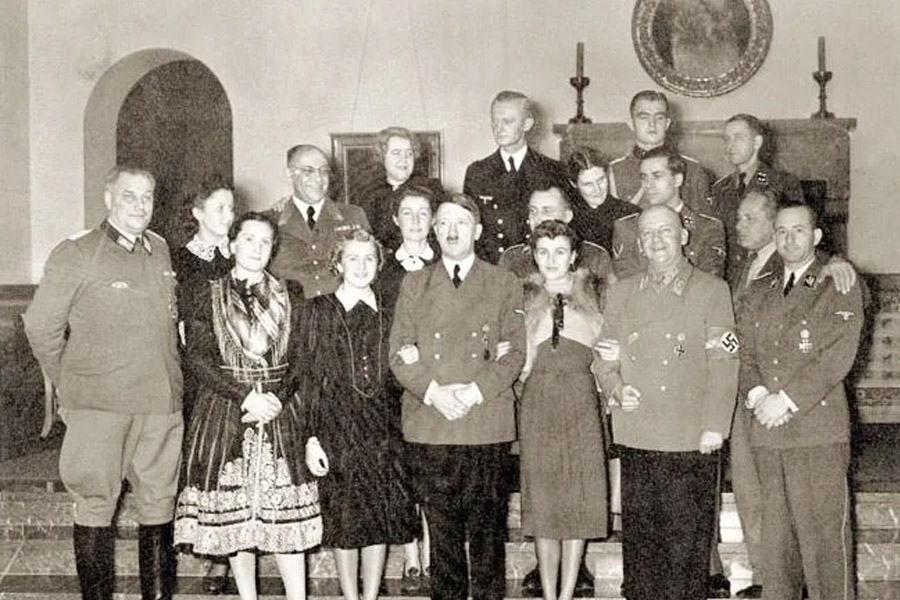
Gerda’s public identity was tied to family, ideology, and motherhood. She trained as a kindergarten teacher in 1927, joined the Nazi Party in April 1929, and married Martin Bormann on 2 September 1929. Adolf Hitler and Rudolf Hess served as witnesses at the wedding, which tells me exactly how close this marriage stood to the political furnace of the regime. From that point on, her life became inseparable from the machinery of Nazi ambition.
The Buch Household and Gerda’s Origins
Gerda was the eldest child in the Buch family. Her father, Walter Buch, was a major Nazi legal figure and chaired the party court. Her mother was Else Buch. In this home, discipline was not a side note. It was the architecture. I imagine a household shaped by judgment, obedience, and ideological certainty, a place where politics and family life were braided together so tightly that separation would have been impossible.
Walter Buch mattered not only as a father but as a symbol of the world Gerda inherited. He was not a distant background figure. He was one of the men helping define Nazi standards of loyalty and punishment. That family environment likely helped form Gerda’s own rigid political convictions. She did not merely marry into Nazism. She had already been raised inside it.
Her siblings were Hans Walter Buch, Lore Buch, and Hermann Buch. Compared with Gerda, they are less visible in the historical record, but they remain part of the same family constellation. I think of them as satellites circling a blazing, destructive star, each bound to the same family gravity.
Martin Bormann, Her Husband and Political Anchor
Martin Bormann was Gerda’s spouse and the central male figure in her adult life. He rose to enormous influence as Hitler’s private secretary and one of the most powerful men in the Third Reich. Their marriage in 1929 joined two deeply committed Nazi families and gave Gerda a place in the upper crust of the regime.
Martin was not only a husband in the personal sense. He was an operator, a gatekeeper, and a bureaucratic force. He controlled access, managed paper trails, and helped shape the daily flow of power around Hitler. For Gerda, this meant a life of privilege, tension, and constant proximity to authority. The marriage also appears to have been troubled. Later accounts describe Martin’s affairs and Gerda’s fierce loyalty to Nazi ideas, even when her domestic life was strained. That tension gives her story a sharp edge. She was not a passive ornament. She was an ideological partner in a marriage tied to violence and control.
The Children, Ten Lives Marked by War and Ideology
Gerda and Martin had 10 children, one of whom died young. Because Nazi ideology permeated the nursery, their family is the best window into her private life.
On April 14, 1930, Adolf Martin Bormann was born. Firstborn and most associated with regime symbolism. The fact that Hitler was his godfather is chilling. After being a priest and missionary, he left.
Born as a twin with Ilse in 1931, Ehrengard Bormann died shortly after birth. She is one of many wartime family names that barely appear before dissolving into despair.
Ilse Bormann (later Eike) was born July 9, 1931. Her life shows how politics and personal symbolism can change family names.
Born July 25, 1933, Irmgard Bormann lived until 2023. Her later existence contrasts with her parents’ violent public life. She married Klotz and outgrew her childhood rule.
Rudolf Gerhard Bormann, born 31 August 1934, became Helmut. He was named after Rudolf Hess, another indicator that the family cherished political commitment.
Heinrich Hugo Bormann was born on June 13, 1936, as Heinrich Himmler in honor. In this family, child names are a sign of loyalty.
Eva Ute Bormann was born 4 May 1938. Family documents list her as a daughter who carried the Bormann line into the conflict.
Born 4 August 1940, Gerda Bormann shared her mother’s name. That repetition counts. This family’s names were formal. They mirrored.
Fritz Hartmut Bormann was born April 3, 1942. He was one of the last newborns before the dictatorship fell.
Volker Bormann was born 18 September 1943 and died 1946. His brief life ends the family tale painfully.
Theodor Schmitz adopted the children after Gerda died. That postwar shift shows family breakdown. One world ended. A colder, more uncertain one began.
Gerda’s Public Role and Ideological Voice
Gerda was more than a wife and mother. She also had a public ideological stance. She became known for promoting Nazi family policy and for advocating ideas that would strengthen the regime’s demographic ambitions. She supported extreme proposals about marriage, reproduction, and the status of children born outside conventional marriage.
This is where her story grows especially unsettling. She was not simply carried along by the system. She believed in it and tried to give it shape. I see her as a woman who converted domestic life into political doctrine. Her voice may not have been as loud as the men around her, but it still carried weight in the narrow world she inhabited.
The Final Years in Italy
After the April 1945 Allied air raid, Gerda escaped Obersalzberg in the closing months of the war. She was diagnosed with uterine cancer in Merano, northern Italy. She died there March 23, 1946. Death ended a life that began in a regimented German household and concluded in a crumbling empire.
The ending is crucial because it dispels permanence. Bormann was formerly a Nazi powerhouse. In a few years, it became a family surviving exile, disease, and defeat.
The Family as a Historical Mirror
I think the Bormann family matters because it shows how ideology can colonize private life. Walter Buch and Else Buch created the household. Gerda entered adulthood already shaped by Nazi conviction. Martin Bormann brought power, ambition, and proximity to Hitler. The children, in turn, were named, raised, and symbolically arranged inside that worldview.
This was not a family standing outside history. It was history in domestic form. The kitchen, the nursery, the wedding, the names, the witness signatures, the political loyalties, all of it formed a single machine. Gerda was one of its visible gears.
FAQ
Who was Gerda Bormann?
Gerda Bormann was a German woman born Gerda Buch in 1909. She was the wife of Martin Bormann, the daughter of Walter Buch and Else Buch, and the mother of ten children. She became known for her deep loyalty to Nazi ideology and her role in promoting Nazi family ideas.
Who were Gerda Bormann’s parents?
Her parents were Walter Buch and Else Buch. Walter Buch was a significant Nazi legal figure and a powerful presence in the party system. Gerda came from a household deeply shaped by ideology and discipline.
Who was Gerda Bormann’s husband?
Her husband was Martin Bormann. They married on 2 September 1929. He later became one of Adolf Hitler’s closest and most powerful aides.
How many children did Gerda Bormann have?
She had ten children, including one who died shortly after birth and another who died in 1946. The children were Adolf Martin, Ehrengard, Ilse, Irmgard, Rudolf Gerhard, Heinrich Hugo, Eva Ute, Gerda, Fritz Hartmut, and Volker.
What was Gerda Bormann known for besides her family?
She was known for her Nazi Party membership, her training as a kindergarten teacher, and her advocacy of extreme Nazi family and marriage ideas. Her life combined domestic identity with political conviction.
When did Gerda Bormann die?
She died on 23 March 1946 in Merano, Italy, after being diagnosed with cancer during the final months of the war.
Why does Gerda Bormann matter in history?
She matters because her life shows how Nazi ideology worked inside the family, not just the state. Through her marriage, children, and political beliefs, she became part of the regime’s intimate human machinery.