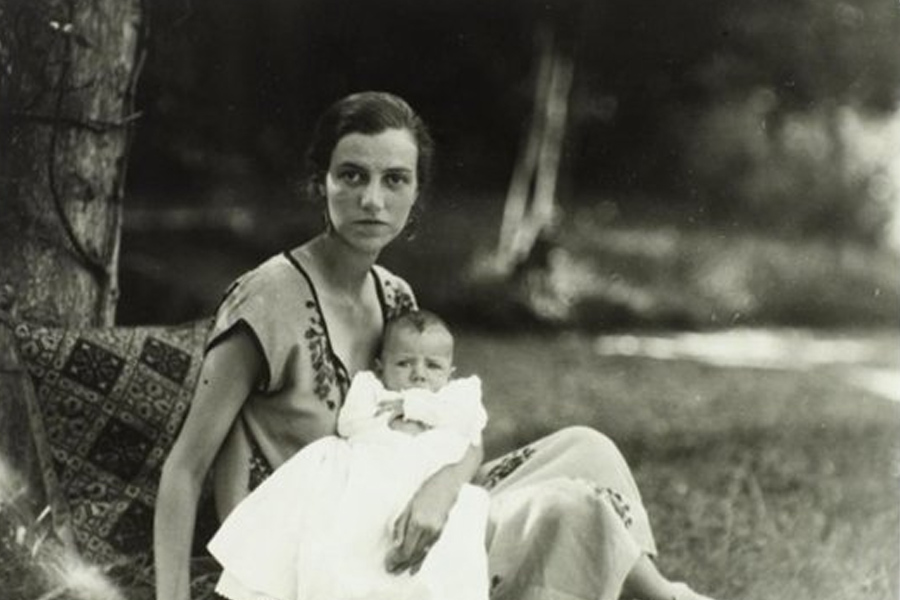
A woman shaped by wealth, loss, and legacy
I think of Florette Seligman as a quiet fixed point in a storm of famous names. She was born in New York City on February 27, 1870, into a family already rooted in finance and social prominence. She later married Benjamin Guggenheim in 1894 and became part of another great American fortune, one built on mining and industry rather than banking. Her life sat at the crossing of two powerful dynasties, and that alone would have made her noteworthy. But what gives her story real weight is the family that gathered around her, the losses she endured, and the children and grandchildren who carried her name into new worlds.
Florette was not known as a public career woman in the modern sense. Her role was more intimate and more enduring. She was daughter, wife, mother, widow, and matriarch. In a society that often turned women into footnotes beside larger male fortunes, she became the steady frame around a dramatic family history. Her life was not a blaze. It was more like a lamp in a high window, visible across decades.
Her parents and the Seligman foundation
Florette was the daughter of James Seligman and Rosa Content Seligman. That fact matters because the Seligman family belonged to the great banking elite of New York. Her father was associated with the formidable financial house of J. & W. Seligman & Co., a firm tied to power, capital, and influence. Being born into that world meant she inherited a social language of privilege, expectations, and polish.
I see her childhood as one shaped by order and discipline, but also by opportunity. The Seligman family was large, and Florette grew up among siblings rather than as an only child in a rarefied bubble. She belonged to a household where wealth was not merely ornamental. It was infrastructure. It supported education, travel, marriage alliances, and the careful choreography of public life.
Her siblings included several figures often named in family records: DeWitt James Seligman, Samuel Jefferson Seligman, Washington Seligman, Eugene Seligman, Jefferson Seligman, Frances Nathan, and Angeline Seligman Gross. That is a full constellation, and Florette stood among them as one branch of a broad family tree. Each sibling represented a continuation of the Seligman name into different social and family networks.
Benjamin Guggenheim and the marriage that joined two fortunes
In 1894, Florette married Benjamin Guggenheim. The marriage joined two major American dynasties, one banking and one industrial. Benjamin was connected to the Guggenheim mining empire, and his reputation was tied to a fortune as glittering as it was heavy, like ore pulled from the earth and refined into power.
Their wedding was a society event, one of those occasions that turned private joy into public theater. In that era, a marriage like theirs was more than a union between two people. It was also a bridge between two economic kingdoms. The ceremony placed Florette at the center of Gilded Age attention, where dress, venue, and guest lists could matter almost as much as the vows themselves.
Together they had three daughters.
| Family member | Relationship to Florette | Notes |
|---|---|---|
| Benjamin Guggenheim | Husband | Wealthy businessman, died in the Titanic disaster in 1912 |
| Benita Rosalind Guggenheim | Daughter | Born in 1895 |
| Marguerite “Peggy” Guggenheim | Daughter | Born in 1898, later became a major art patron and collector |
| Barbara Hazel Guggenheim | Daughter | Born in 1903, later known as an artist and collector |
This family structure is central to understanding Florette. She was not simply attached to the Guggenheim name through marriage. She became the mother of daughters whose lives would each move in different directions, one into marriage and early death, one into art and cultural legend, and one into painting and collecting.
The shock of 1912 and the widow years
The year 1912 changed everything. Benjamin Guggenheim died in the Titanic disaster, and Florette was left a widow with three daughters. That kind of loss can split a life into before and after with the precision of a broken blade.
From the surviving accounts, I picture Florette as someone forced to move from grandeur to management. She had to handle grief, public attention, estate matters, and the practical burdens of motherhood at once. The family’s world did not vanish after Benjamin’s death, but it shifted. The shine remained, yet it became more complicated, less theatrical, more fragile.
By 1915, she was still living at the St. Regis while attorneys dealt with Benjamin’s estate. That detail says a great deal. It shows her in a transitional space, still attached to luxury, still tied to the old life, but now navigating it without the husband who had once anchored it. In the same period, she also managed a townhouse on East 72nd Street, a residence that marked the family’s place in New York high society.
I find this part of her life especially revealing. The widow years are often where history hides a woman’s real labor. She may not have held a formal title or public office, but she carried the weight of continuity. She preserved the family line while the world watched the daughters grow.
Her children and the branching of a legacy
Florette’s firstborn was 1895-born Benita Rosalind Guggenheim. She lived shorter than others. She married Edward Bloom Mayer in 1919 and died aged 31 in 1927. Even though her life is brief, it follows elite family history, where marriage, name changes, and early death can define a biography.
The most famous of Florette’s children was 1898-born Peggy Guggenheim. She became a renowned modern art collector, supporter, and promoter. Her museums, galleries, and acquisitions made her a 20th-century cultural icon. Florette helped retain the older family world underneath that current aura. Peggy’s path was not random. It came from inheritance, upbringing, and the complex inheritance of taste, money, and freedom.
The 1903-born Barbara Hazel Guggenheim chose another course. Eventually, she painted and collected art. Her family used art as oxygen, not decoration. The daughters inhaled it. Not only was Florette’s family wealthy. This was productive. It produced women with social, artistic, and personal impact.
Grandchildren and the widening circle
Florette also became a grandmother. Through Peggy, she had grandchildren including Michael Cedric Sindbad Vail and Pegeen Vail Guggenheim. Pegeen, in particular, is remembered as part of the artistic Guggenheim line, carrying the family’s restless creative energy into another generation.
Through Hazel, she also had grandchildren tied to the later Guggenheim family branches, including John King-Farlow and Barbara Benita King-Farlow. The family tree stretched outward like a river delta, splitting and widening as generations passed.
This matters because Florette’s biography is not just about her own lifespan. It is about transmission. She stood at the center of a household that produced children and grandchildren whose lives continued to echo in art, memory, and genealogy.
Financial standing and social position
Florette’s fortunes are better understood through her families rather than her career. Seligmans symbolized financial wealth. The Guggenheims represented mining and industrial prosperity. This put her in one of her era’s strongest income brackets.
Her financial life undoubtedly became more administrative and estate-focused after Benjamin’s death. The surviving references cover attorneys, claims, inheritance, and property. The family townhouse was sold in 1919. The act is telling. Houses can be architecture or memory in bricks. Selling it ends one chapter and resets another.
Her finances are like a vault with a lengthy shadow. Large wealth was related to institutions, inheritance, and masculine public jobs. Florette helped save the family line following a major breakup.
FAQ
Who was Florette Seligman?
Florette Seligman was a New York woman born in 1870 who came from the Seligman banking family and married Benjamin Guggenheim in 1894. She became the mother of three daughters and the grandmother of several notable descendants.
Who were Florette Seligman’s parents?
Her parents were James Seligman and Rosa Content Seligman. Her father belonged to the influential Seligman banking family.
Who was Florette Seligman’s husband?
Her husband was Benjamin Guggenheim, a wealthy businessman linked to the Guggenheim mining fortune. He died in the Titanic disaster in 1912.
How many children did Florette Seligman have?
She had three daughters: Benita Rosalind Guggenheim, Peggy Guggenheim, and Barbara Hazel Guggenheim.
Why is Florette Seligman remembered today?
She is remembered because she stood at the center of two major American families and because her children and grandchildren became historically significant, especially Peggy Guggenheim in the art world.
Did Florette Seligman have a public career?
I did not find evidence of a public professional career. Her historical importance comes mainly from her family role, inheritance position, and place within the Seligman and Guggenheim dynasties.
What happened to Florette Seligman after Benjamin Guggenheim died?
After Benjamin’s death in 1912, she remained a widow in New York, managed family and estate matters, lived at elite hotels during parts of the transition, and later sold the family townhouse in 1919.