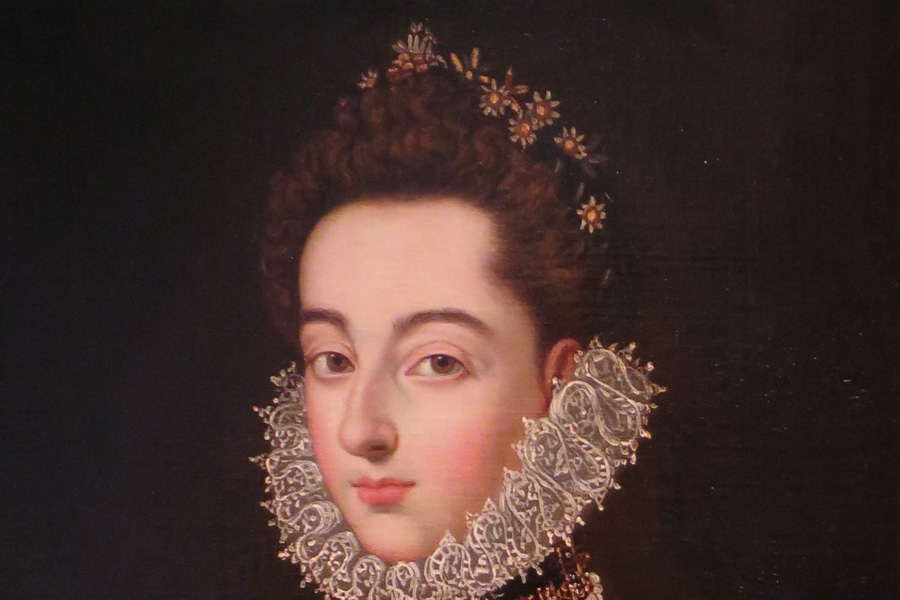
A Princess Shaped by Courts, Letters, and Bloodlines
When I look at Catalina Micaela Of Spain, I see a woman formed at the bright center of European power. She was born on 10 October 1567 in Madrid, the daughter of Philip II of Spain and Elisabeth of Valois. That alone placed her in a world where crowns were not ornaments but instruments, and where every marriage could shift the balance of kingdoms. She was not merely a princess in a painted gown. She was a political bridge, a sister, a wife, a mother of ten children, and a ruler in her own right.
Her childhood was marked by privilege, loss, and expectation. Her mother died in 1568, only a year after Catalina’s birth. Her father, Philip II, remained one of the most powerful monarchs in Europe, and her elder sister Isabella Clara Eugenia became her closest sibling and lifelong companion in the memory of the Spanish court. Catalina grew up where discipline was dense as velvet and where the future was often discussed before breakfast.
The Spanish Family She Was Born Into
Catalina’s family tree is a web of imperial consequence. Her father, Philip II of Spain, belonged to the Habsburg dynasty, a house that stretched across Spain, the Low Countries, parts of Italy, and beyond. Her mother, Elisabeth of Valois, connected her to the French royal line and to the world of Catherine de’ Medici. Through Elisabeth, Catalina was a granddaughter of Henry II of France and Catherine de’ Medici. Through Philip II, she was also descended from Charles V and Isabella of Portugal.
Her full sister Isabella Clara Eugenia was her nearest companion in both blood and destiny. The two sisters were often remembered together in portraits and in court culture. I think of them as twin candles in the same chapel, each bright, each distinct, and both lit for dynastic purpose.
Catalina also gained half-siblings through her father’s later marriage to Anna of Austria. Among them were Philip III of Spain, who would later inherit the throne, along with other children who died young. This enlarged family reminded me that royal life was never private. It was an expanding ledger of alliances, grief, and succession.
Marriage to Charles Emmanuel I and Life in Savoy
Catalina married Charles Emmanuel I, Duke of Savoy, on 11 March 1585 in Zaragoza. This was no simple courtship. It was a political marriage with a glittering surface and serious intent beneath it. Savoy sat like a hinge between France, Spain, and Italy. By marrying Catalina, Charles Emmanuel tied his house more tightly to the Spanish world.
She entered Turin in August 1585, and from that point her life became deeply tied to Savoy. The marriage was productive in every sense that mattered to dynasties. Catalina gave birth to ten children over just eleven years. That number alone tells a story of endurance. Her body carried both the future of Savoy and the cost of monarchy.
Yet she was more than a vessel for succession. I see her as a governing presence. When her husband was absent on military campaigns, Catalina acted as his lieutenant and later as regent. She handled administration, diplomacy, and finances. In a court where many women were expected to decorate power, she helped operate it.
Catalina Micaela Of Spain as a Political Actor
Her role in Savoy revealed a sharp and practical intelligence. At first, some at court disliked her Spanish style and the forms she brought with her. That reaction was predictable. Courts resist change the way armor resists a blade. But Catalina persisted, and over time she earned respect for her political judgment.
She is remembered as having defended Savoy’s autonomy with firmness. She did not simply echo Spain or obey her husband blindly. She understood the value of leverage. She knew that a duchess could be a hinge, and a hinge can move a heavy door.
Catalina also left a cultural mark. She supported court life, patronage, and building projects. Her world was one of letters, portraits, ceremonial display, and careful household management. She lived in an age when image mattered almost as much as policy. A portrait could carry affection, prestige, and memory in a single frame.
Her Children and the Branching Dynasty
Catalina Micaela’s offspring created a major late sixteenth-century European dynasty. Each child connected Savoy to more power. Because her family moved, this element of her narrative strikes me. It grew like roots under stone.
Her firstborn was Prince Philip Emmanuel of Piedmont. He was the first heir, but he died young. Her second son, Victor Amadeus I, became Duke of Savoy and advanced the house. Emanuel Filibert, another son, became Viceroy of Sicily, demonstrating Savoyard blood in Spanish imperial structures. Thomas Francis developed the Carignano branch, which would be important later in European history.
The family expanded with her daughters. Margaret became Duchess of Mantua and Montferrat after marrying Gonzaga. Isabella married Este and became Modena’s princess. Francesca Caterina and Maria Apollonia became believers. Maurice became cardinal. Born in 1597, Giovanna died that year. The children made a constellation, with Catalina at the center like a sun that gave light and gravity.
The Husband She Loved and the Court She Managed
Catalina’s political and emotional match was Charles Emmanuel I. Survival of their letters implies fondness. That matters. Dynastic couples frequently sacrifice tenderness first. They kept it alongside ambition.
It seems like their relationship is a deal based on emotion and strategy. The warrior duke. She stabilized home machinery. They had heirs, managed alliances, and shaped Savoy.
Royal ladies face terrible hazards, as her death in Turin on November 6, 1597, was during childbirth. At 30, she was young. Her last child, Giovanna, died. Her final years seem triumphant and dangerous, like a bridge across a river that could overflow at any time.
Why Catalina Micaela Of Spain Still Matters
What makes Catalina Micaela Of Spain memorable is not just her rank. It is the combination of intellect, duty, and endurance. She was born into one of Europe’s most powerful families, married into another significant house, and used her position with surprising force. She lived inside ceremony, but she did not become ceremonial herself.
Her story also shows how women in dynastic Europe could wield influence through management, correspondence, patronage, and regency. She was part diplomat, part administrator, part mother of a future ruling line. Her life was short, but it branched outward for generations.
FAQ
Who were Catalina Micaela Of Spain’s parents?
Her parents were Philip II of Spain and Elisabeth of Valois. Through them, she belonged to both the Spanish Habsburg world and the French royal line.
Who was Catalina Micaela Of Spain’s sister?
Her full sister was Isabella Clara Eugenia. The two sisters were closely connected in childhood and in court memory, and they were often represented together.
Who was Catalina Micaela Of Spain’s husband?
She married Charles Emmanuel I, Duke of Savoy. Their marriage joined Spain and Savoy and became one of the defining alliances of her life.
How many children did Catalina Micaela Of Spain have?
She had ten children. Her children included future rulers, nobles, a cardinal, and religious figures, making her one of the key dynastic mothers of her age.
What was Catalina Micaela Of Spain known for besides marriage and motherhood?
She was known for governing Savoy during her husband’s absences, handling administration and diplomacy, and defending the duchy’s autonomy with real political skill.
When did Catalina Micaela Of Spain die?
She died on 6 November 1597 in Turin, after a childbirth related death. She was 30 years old.
Why is Catalina Micaela Of Spain important in history?
I would say she matters because she united royal bloodlines, shaped Savoy’s government, and left behind a family that influenced several European courts for generations.